
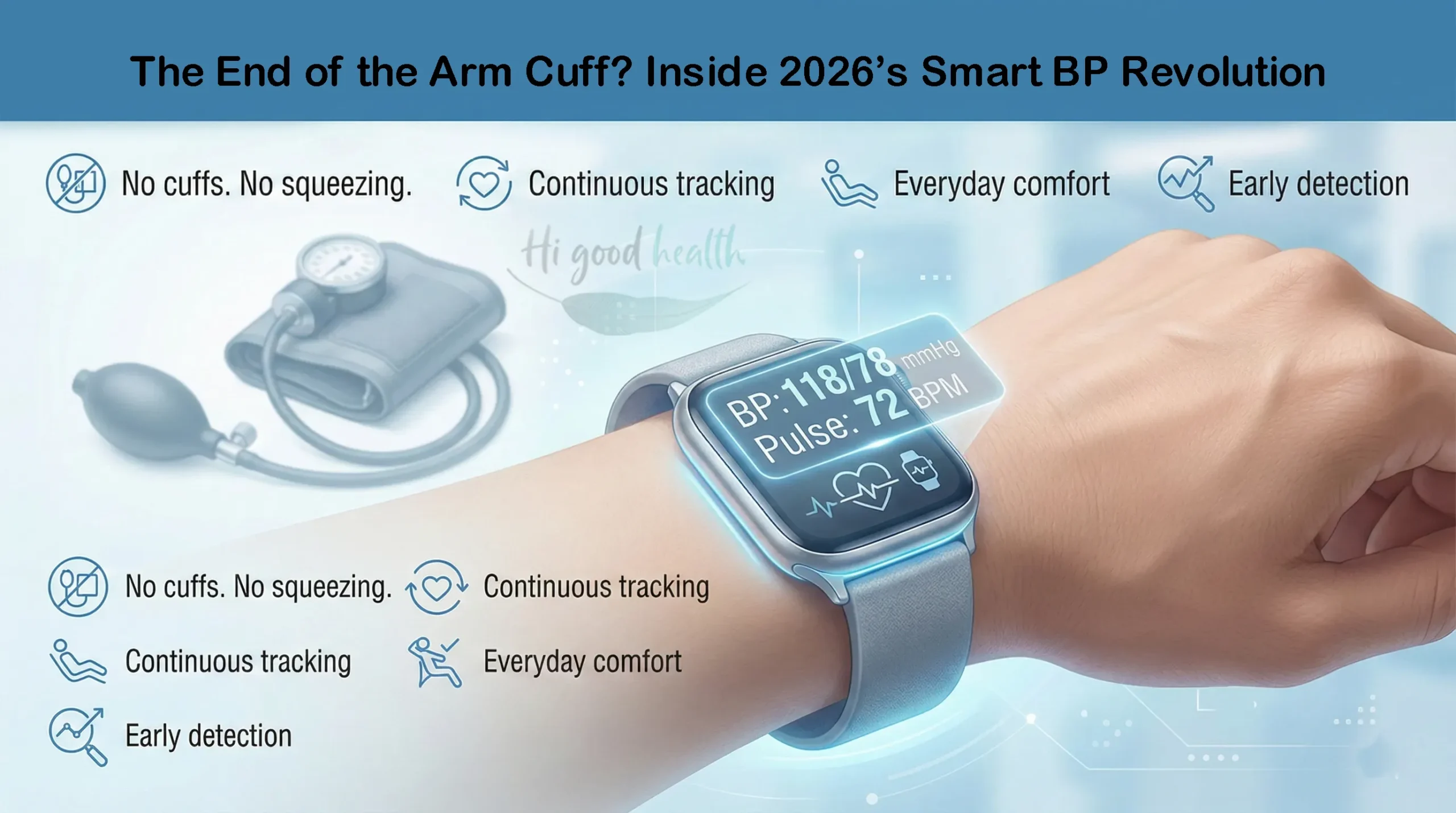
Imagine checking your blood pressure as easily as glancing at your watch—no squeezing, no discomfort, and no interruptions to your day. This futuristic vision is finally becoming a reality. Welcome to the world of cuffless blood pressure (BP) monitoring.
Ask any doctor, and they’ll tell you that high blood pressure is one of the biggest silent threats to health, affecting nearly half of all US adults. Catching and controlling it early saves lives, but traditional “cuff” monitors can be awkward to use and can sometimes give misleading results. This has led to misdiagnosis for nearly 40% of patients due to “white coat syndrome,” according to Vivalink CEO Jiang Li.
At Letusbehealthy.com, our mission is to make credible health science understandable for everyone. Our goal is to empower you and your loved ones to track and take control of your health with the latest, proven science. We want to clear the confusion and help you find health tools that actually work.
How Cuffless Blood Pressure Monitors Work
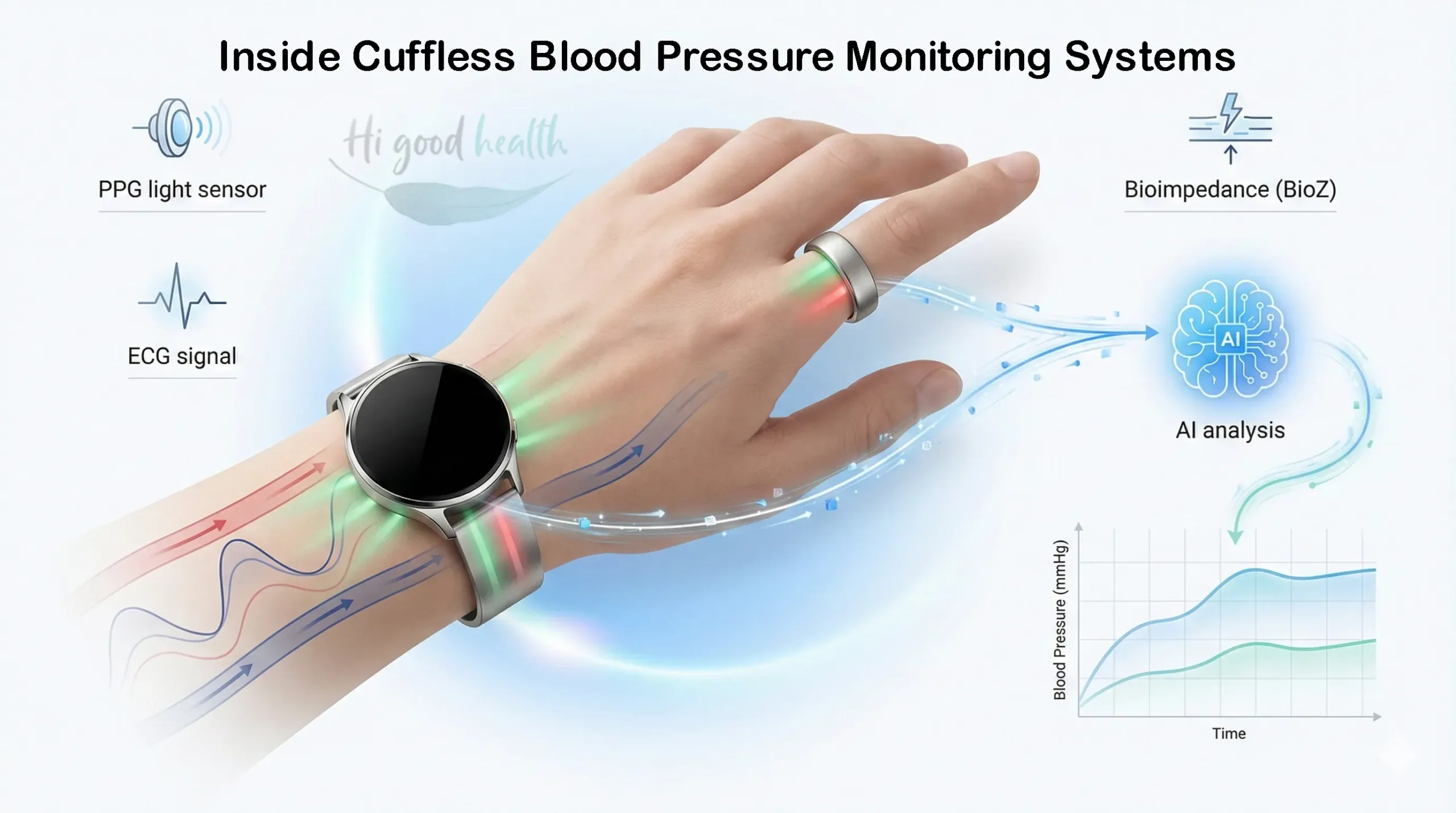
Instead of inflating a cuff, these devices use clever sensors and AI. Most use a technology called photoplethysmography (PPG), which shines a light through your skin to measure changes in blood flow. Others may also use ECG (Electrocardiogram) or Bioimpedance (BioZ) signals to measure your pulse and blood pressure.
These wearables, whether a sleek wristband or a discreet ring, can collect data continuously—even while you sleep. This provides a much more reliable, long-term view of your health than a once-a-week spot check.
Latest Studies & Science Explained
Are these devices accurate? It’s a big question. Recent studies published in 2026 show that some cuffless monitors, like the widely studied Aktiia device, provide blood pressure results that nearly match “gold standard” 24-hour ambulatory monitors, especially for daytime readings.
However, nighttime and exercise readings remain less consistent. A 2026 review in
JAMA Cardiology warns that not all cuffless devices have gone through proper validation, so it’s crucial to check for FDA status and independent testing before you buy. As Dr. Eugene Yang, a professor of medicine, cautions, “Accuracy with risk of undertreatment or overtreatment remain key concerns… we should not rely on [unvalidated] data from these devices”.
The good news is that AI is helping to close this gap. Developers are increasingly using deep learning to compensate for factors like skin tone, wrist position, and movement, which is shrinking errors to below 5 mmHg, and many meet international accuracy standards.
A Head-to-Head Comparison: 2026
Here’s what real users and experts are saying about the top cuffless BP monitors on the market or coming soon.
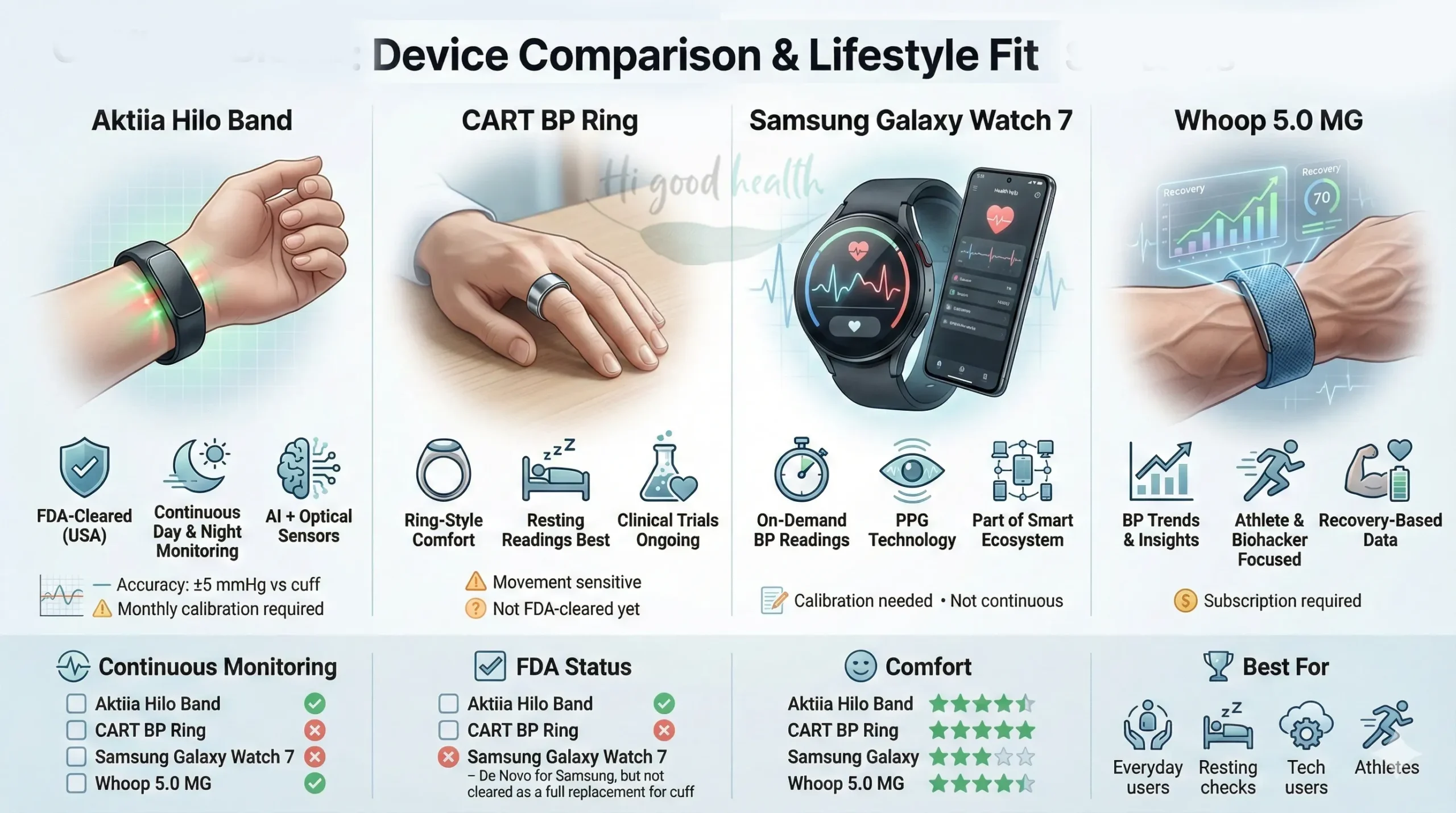
Aktiia Hilo Band: The most talked-about release of the year is the Aktiia Hilo Band, the first FDA-cleared cuffless BP monitor for over-the-counter use in the USA. This sleek wristband uses optical sensors and AI to measure BP comfortably, day and night.
- Real-World Feedback: Users love the comfort, with many saying it “feels like a regular fitness tracker”. The app is also praised for its easy setup and useful charts that can be shared with a doctor.
- Accuracy: Early users and trials report daytime accuracy within 5 mmHg of medical-grade cuffs. Aktiia’s CTO, Jose Sola, calls this not just a regulatory achievement, but “the beginning of a transformation in hypertension management”.
- Drawbacks: Nighttime readings can sometimes drift, and monthly calibration is required. It’s best for everyday checks and long-term trend tracking.
CART BP: This ring-style wearable is expected to arrive in the US soon. Early reviews from clinical trials note its ease-of-use, with one user saying, “I hate arm cuffs, so slipping on a ring is a game-changer”. It’s also praised for its health app integration, which allows for direct sharing with doctors or family. However, it only works well for resting readings due to finger movement sensitivity and is not yet FDA-cleared.
Samsung Galaxy Watch 7: This smartwatch uses PPG technology for on-demand cuffless BP readings after calibration. It delivers readings in seconds and is popular with tech-savvy users who want BP tracking as part of a full smart ecosystem. The main drawback is that it’s not a continuous monitor, and the BP feature has regional and phone pairing limits.
Whoop 5.0 MG: This screenless band adds BP tracking to its recovery-focused system. It provides “BP insights” and trends rather than absolute numbers. It’s best for athletes or “biohackers” who want a holistic view of their health, but its high subscription cost may be a barrier for some.
What Experts and Social Media Say
Instagram and YouTube are packed with unboxing videos and comparisons, but a common thread emerges: users and experts alike stress the need for calibration and doctor confirmation. The American Heart Association and experts like Dr. Eugene Yang echo this, stating that while these devices offer comfort, their clinical usefulness is still limited until more validation data is available.
Our Doctor’s Take & Expert Advice
As a practicing physician and tech enthusiast, I’ve seen more families bring in apps showing daily BP trends. In most cases, these devices align well with daytime readings, but I always confirm major changes with a verified cuff system, especially for dose adjustments. Dr. Yang’s advice echoes mine: use cuffless devices for long-term trends and home tracking, but keep your regular cuff for key clinical reviews.
The purpose of higoodhealth.com is to share honest, clear health reviews and empower families everywhere—no jargon, just results you can trust. We review only the most credible real-world experiences and the latest scientific consensus.
If you prefer a more visual version, check out our YouTube video here:
Frequently Asked Questions (FAQ)
- Q1: Which cuffless BP device is most accurate right now? The FDA-cleared Hilo Band leads, with day-to-day readings closest to verified results.
- Q2: Can I use results for diagnosis? Trends from cuffless monitors are useful, but always confirm important results with your doctor and a validated device.
- Q3: Are cuffless BP monitors safe for kids? Cuffless devices like Hilo Band are currently approved for adults, but new releases sized for teens and children are coming soon.
- Q4: Do cuffless monitors replace home cuff monitors? Not yet! They complement each other for most people.
- Q5: How does calibration work? Most require matching with a standard cuff periodically, and the device/app gives you reminders.
Glossary
- Cuffless BP: Measurement of blood pressure without an arm cuff.
- FDA-cleared: Certified as safe and accurate for medical use by the US Food & Drug Administration.
- Calibration: Setting up a device with reference measurements from a standard cuff.
- PPG (Photoplethysmography): Sensing blood flow with light.
- White coat syndrome: Blood pressure rises due to anxiety in medical settings.
External Sources and Further Reading
