
The culinary world holds mushrooms and truffles in high regard. They are commonly embraced as reliable vegetarian choices. However, a closer examination may reveal subtle complexities that challenge this assumption. This exploration is not about rejecting fungi as food, but rather about cultivating a deeper awareness of their ecological roles. It encourages thoughtful reflection, especially for conscientious eaters globally . As we peel back these earthy layers, what we discover might shift how we perceive these widely beloved ingredients.
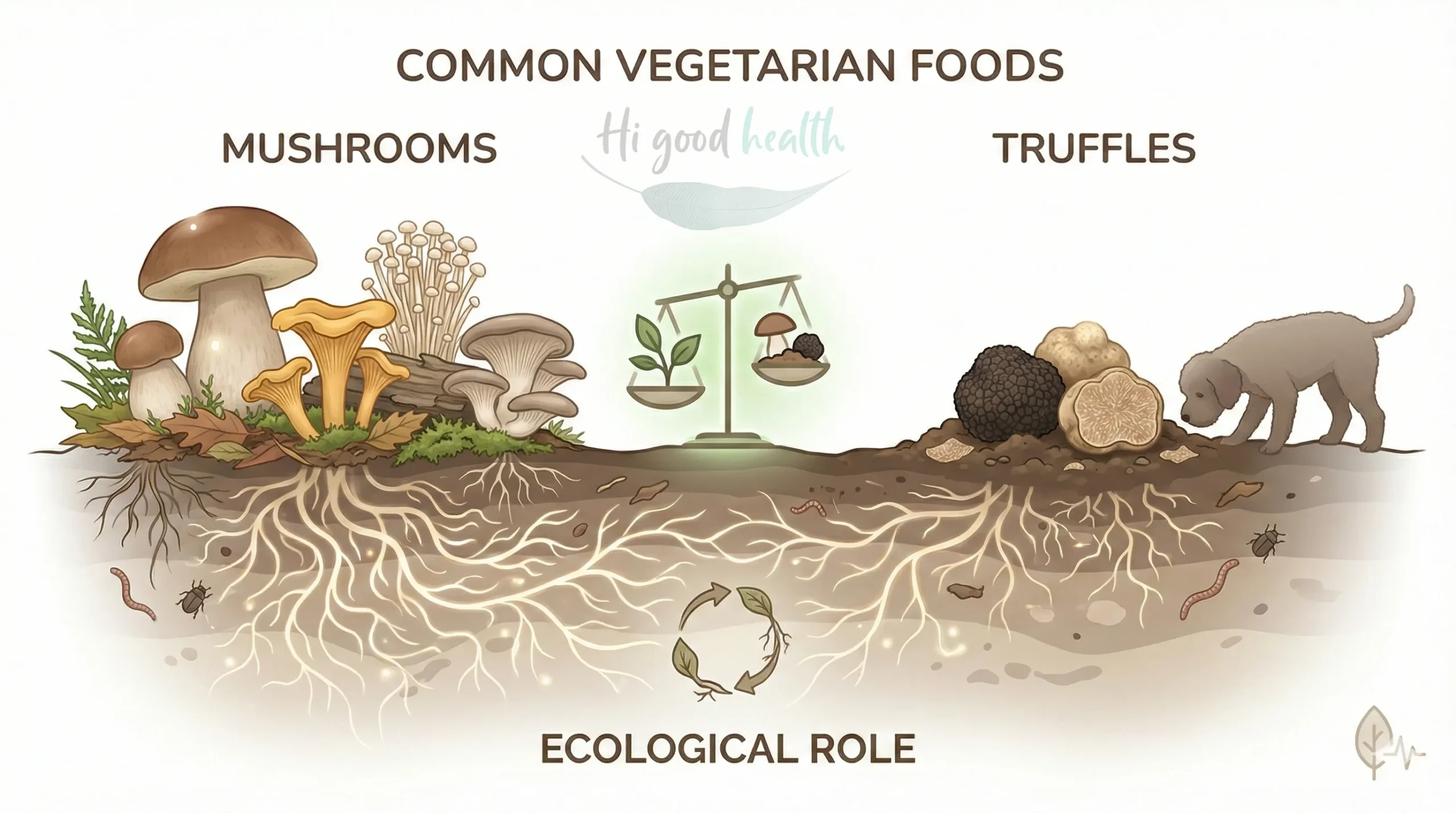
What Exactly are Fungi?
Fungi are one of the major kingdoms of life, separate from plants and animals. Unlike plants, they do not contain chlorophyll and do not produce their own food through photosynthesis. Fungi are not autotrophs, like plants and some bacteria. This style of feeding separates them and makes them a distinctive life form with complex interrelationships within nature’s food pyramid. Understanding this difference is crucial if we are to comprehend their true nature and ecological significance.
How are Mushrooms different from Truffles?
Mushrooms and truffles are both fungi, but they differ greatly in appearance, growth, taste, and how they are harvested.
| Feature | Mushrooms | Truffles |
| Type | Fungi | Fungi |
| Growth Location | Above ground on soil or wood | Underground near tree roots |
| Shape | Cap and stem | Irregular, roundish |
| Size | Varies widely | Usually small and lumpy |
| Color | Various colors | Typically black or white |
| Aroma | Mild to earthy | Strong, musky, unique |
| Taste | Subtle to umami | Intense and savory |
| Texture | Smooth to spongy | Firm and dense |
| Harvest Method | Handpicked | Dug up with trained dogs or pigs |
| Rarity | Common | Rare |
| Growing Conditions | Cultivated easily | Very specific and hard to cultivate |
| Culinary Use | Common in everyday dishes | Used in gourmet cuisine |
| Price | Affordable | Extremely expensive |
| Shelf Life | Longer with refrigeration | Short, very perishable |
| Nutritional Value | Good source of fiber and B vitamins | Rich in antioxidants |
| Popular Varieties | Button, shiitake, portobello | Black truffle, white truffle |
| Region Found | Worldwide | Mainly Europe (Italy, France) |
| Seasonality | Year-round availability | Seasonal |
| Cultivation Ease | Easy to farm | Difficult and time-consuming |
| Status | Everyday food | Luxury delicacy |
Are Truffles “Ethically Sourced” for the Strict Vegetarian?
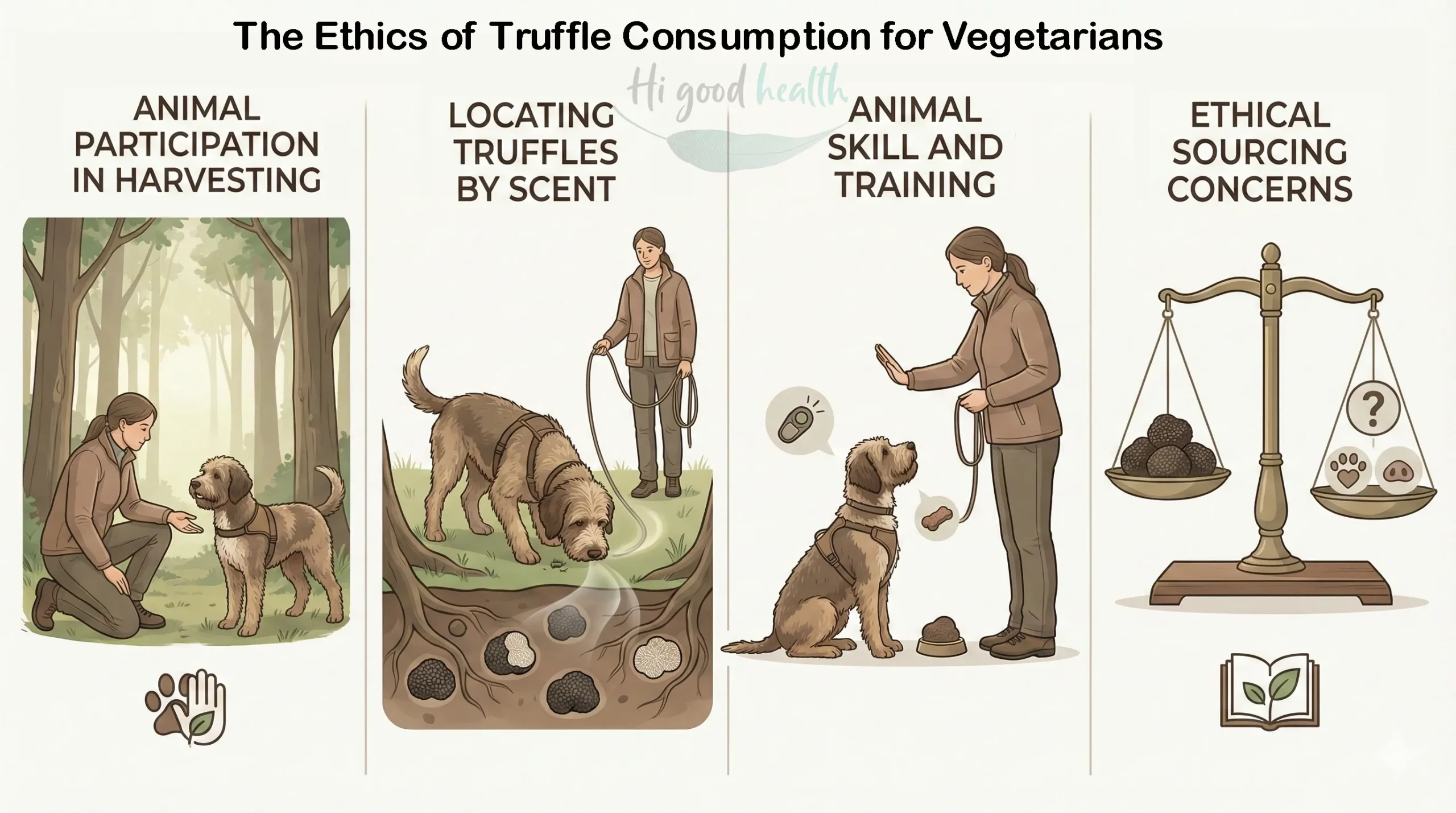
Truffle harvesting often evokes romantic images of animals and humans working in harmony. Traditionally, pigs—valued for their acute sense of smell—were used to locate truffles. Nowadays, trained dogs are more commonly employed. While truffles themselves are fungi, the method of harvesting involves deliberate use of animal labor and training. For vegetarians who prioritize ethical sourcing, the dependence on animals in this process presents a significant philosophical concern.
- Animal participation is key in truffle harvesting.
- Dogs are commonly used to locate truffles.
- Animal skill and training are integral to the process.
- Ethical sourcing raises important questions.
The Mycorrhizal Mystique: A Symbiotic Relationship with Unseen Partners.
Most edible fungi (including premium truffles) form a symbiotic relationship, called mycorrhiza, with a variety of tree roots. In these partnerships, fungal networks allow the plants to take up nutrients more effectively in exchange for carbohydrates. But these relationships are more complicated than just plant versus fungus. There’s a myriad of microbial life in the surrounding soil, as well as small invertebrates, all connected in the delicate web that is this ecosystem.
- Fungi maintain deep-rooted partnerships with plants.
- They exchange essential nutrients for mutual benefit.
- The system involves a wide array of organisms.
- Ecosystem boundaries are often blurred.
Beyond the Soil: Do Fungi Feed on “Forbidden” Foods?
Fungi are nature’s foremost decomposers. They break down organic material, recycling nutrients back into the ecosystem. While they often feed on decaying plant matter like wood and leaves, they do not discriminate between plant and animal sources. In their natural habitat, fungi may also absorb nutrients from dead insects or animal remains. While they do not consume meat in the conventional sense, their nourishment may come indirectly from animal life.
- Fungi recycle organic waste in nature.
- They thrive on decaying matter, plant or animal.
- Their nourishment sources are diverse.
- The food chain they participate in is multifaceted.
The “Wild Harvest” Dilemma: Where Purity Gets Perplexing.
Wild mushrooms and truffles grow in the wild. Unlike the type grown on farms, these fungi roll around in nutrients from the the wilds, and that includes rotting plants and dead animals. The fungi are no animals, but their soil can be fed by animal residues or micro material. This mixing of natural functions is certainly a legitimate concern to those who advocate strict vegetarianism.
- Wild fungi grow in uncontrolled conditions.
- Interaction with animal matter is possible.
- Nature does not guarantee sterility.
- Absolute purity is difficult to assure.
Cultivated Control: Does a Farmed Mushroom Guarantee Vegetarianism?
Commercially cultivated mushrooms such as button, shiitake, or oyster mushrooms are generally grown in sterilized, plant-based substrates like sawdust or straw. These controlled environments aim to eliminate external contamination. However, achieving complete purity remains a challenge, as microorganisms are ever-present. While considerable effort is made to maintain vegetarian standards, the biological nature of fungi calls for careful monitoring.
- Substrate purity plays a critical role.
- Sterilization helps reduce contamination.
- Total exclusion of life forms is improbable.
- Vigilance is essential, even in controlled settings.
The Life Cycle Loop: Is There a Hidden Animal Link in Fungal Propagation?
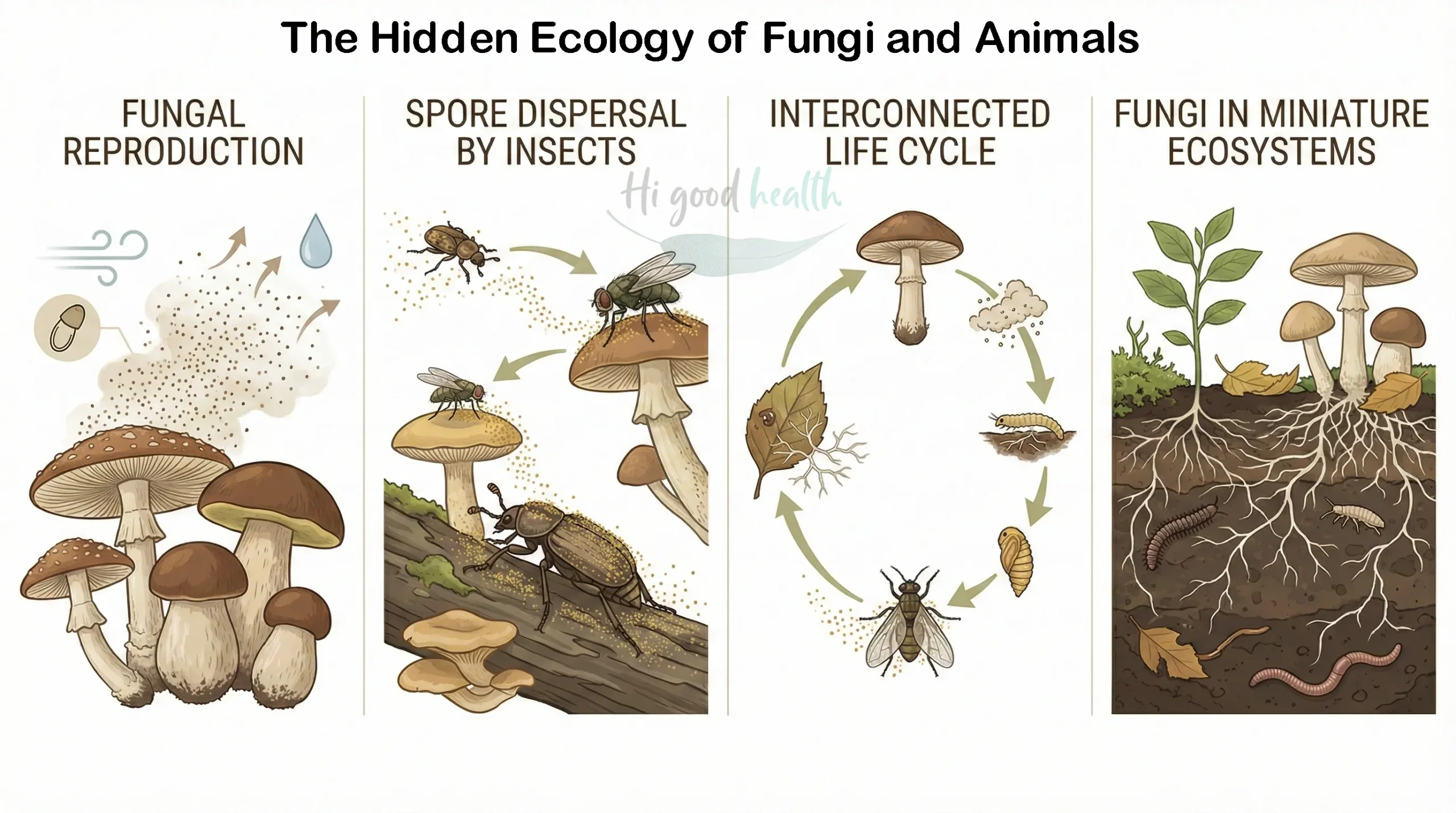
Some fungi have life cycles that depend on animal carriers. Fungal Spore Distribution/Fungal Reproduction, in certain communities, insects and lower invertebrates help to spread spores or to promote reproduction of mold. But although the fungi are certainly not animals, their life cycles in several cases have evolved to become dependent on it. This emphasizes how deeply connected all the organisms in nature really are.
- Fungal reproduction can involve other organisms.
- Insects may play a role in spore dispersal.
- The life cycle is not always independent.
- Fungi are part of miniature ecosystems.
Defining Vegetarian: Is It Only About the Final Product?
Vegetarianism is interpreted differently across cultures and individuals. For some, it simply means abstaining from animal flesh. Others, particularly those guided by ethical or spiritual principles, may extend this definition to include the production process. If a food source inherently involves animals—directly or indirectly—it prompts reevaluation. Thus, what is considered “vegetarian” may depend not only on the end product but on its entire journey.
Your Plate, Your Principles: Navigating the Nuances.
Food choices are deeply personal. By exploring the ecological roles and intricacies of fungi, individuals can more consciously make informed decisions. This is not an indictment of mushrooms, or truffles. It’s an invitation to unveil the complex routes that food takes to reach us, to raise awareness and promote informed choices about our edible selves in an informed way.
Key Takeaway: The Unsettling Truth
Mushrooms and truffles, though not derived from animals, exist within rich ecosystems where animal interactions are often unavoidable. Their growth, harvesting, and propagation present ethical nuances that challenge a simplistic vegetarian classification. The answer isn’t black or white. It lies in understanding nature’s complexity and deciding where one’s own ethical lines are drawn. In the end, every plate tells a story—and that story is yours to shape.
If you prefer a more visual version, check out our YouTube video here:
FAQs
Are mushrooms and truffles considered plants? No, they are not plants. Fungi belong to a separate kingdom of life. Unlike plants, they do not have chlorophyll and cannot produce their own food through photosynthesis. Instead, they act as decomposers, recycling nutrients from organic material in their environment.
What is the main difference between a mushroom and a truffle? While both are fungi, they grow very differently. Mushrooms typically grow above ground on wood or soil and are easy to farm. Truffles grow underground near tree roots, are seasonal, difficult to cultivate, and are considered a rare luxury delicacy compared to the affordable mushroom.
Are truffles vegan or vegetarian friendly? They are generally accepted as vegetarian, but strict definitions vary. Truffles are fungi, not animals. However, because harvesting often relies on trained dogs or pigs, some strict vegetarians view this animal labor as an ethical concern.
Why are truffles so expensive compared to regular mushrooms? Truffles are extremely expensive because they are rare and require very specific growing conditions that are hard to replicate. Unlike mushrooms, which are easily farmed year-round, truffles are seasonal and often must be hunted individually using animals.
Do wild mushrooms or truffles contain animal ingredients? They do not contain meat, but their nutrient source can be complex. In the wild, fungi absorb nutrients from decaying matter, which may include rotting plants, insects, or animal remains. While they don’t “eat” meat, they may derive nourishment indirectly from animal life.
Are store-bought mushrooms cleaner than wild ones? Generally, yes. Commercially cultivated mushrooms (like button or shiitake) are usually grown in sterilized, plant-based substrates like sawdust or straw to prevent contamination. However, total sterility is difficult to guarantee, even in controlled environments.
Do they still use pigs to hunt for truffles? Traditionally, pigs were used because of their excellent sense of smell, but today, trained dogs are more commonly used to locate truffles. This shift has occurred, but the process still relies on animal participation, which is a key point for ethical sourcing discussions.
Does eating fungi support a specific food chain? Yes. Fungi are essential decomposers that connect various parts of the ecosystem. They form symbiotic relationships with tree roots to exchange nutrients. By consuming them, you are participating in a complex web that includes trees, soil microbes, and organic recyclers
